A good CCNA practice test does two jobs. It shows you which exam topics you can already handle, and it shows you exactly which ones you can’t. Take one early, review every miss, fix the gap with a lesson or a lab, then test again. Scores matter less than what you do with the questions you got wrong.
This guide covers what a CCNA practice test should contain, where to find free questions, how to tell good questions from bad ones, and a repeatable method for turning results into a study plan.
TL;DR
- Use practice tests as a diagnostic first and a scoreboard second. Start early, not the week before the exam.
- Match your questions to the exam blueprint: five domains, each with a published weight.
- Free sources exist, including Cisco’s own Exam Review tool with nearly 300 questions and 15 lab exercises.
- Log every missed question by topic and cause (knowledge, misread, or command syntax), then repair the topic with a lesson or lab before retesting.
- Treat memorized answers as a risk. The exam rewards understanding and hands-on skill.
Table of Contents
- What a CCNA practice test should cover
- Where to find free CCNA practice questions
- How to judge whether CCNA exam questions are any good
- A repeatable method for using practice-test results
- Worked example: turning one bad score into a plan
- Lab-style questions: practice with a keyboard
- Is the CCNA hard, and what do scores tell you?
- Perspective: why we build practice around mistakes
- Put the method to work
- A four-week plan around practice tests
- Common mistakes to avoid
- FAQ
- Sources
What a CCNA practice test should cover
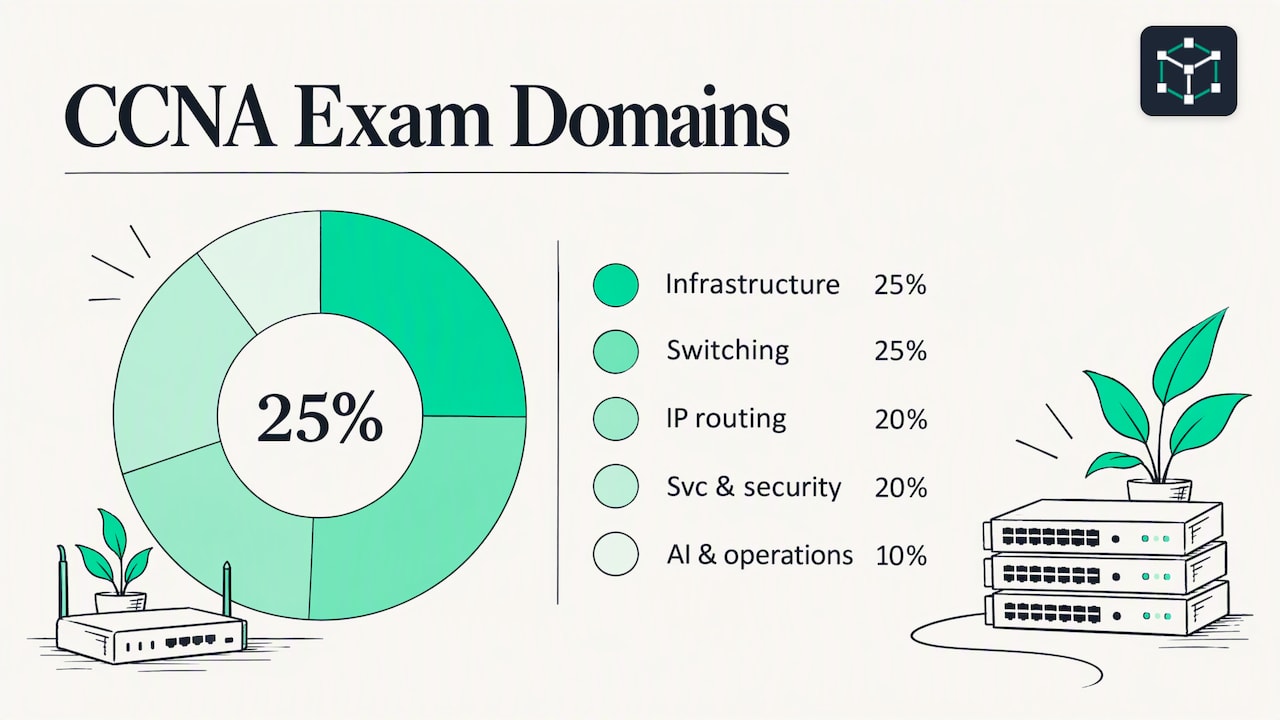
The CCNA certification is built around a published exam blueprint. The 200-301 exam is being updated to version 2.0, and Cisco’s v2.0 topic list gives five domains with these weights:
| Domain | Weight |
|---|---|
| Network Infrastructure and Connectivity | 25% |
| Switching and Network Access | 25% |
| IP Routing | 20% |
| Network Services and Security | 20% |
| AI, and Network Operations and Management | 10% |
The first v2.0 test date listed on that page is February 3, 2027. Check the page for the current version before you pick study material, because the topic list is what the exam is written from.
A practice test worth your time follows the same proportions. If 90% of the questions are about subnetting and OSPF, you will feel ready and still be exposed on security, services and operations. Count the questions by domain after each attempt. If one domain is thin, look for extra questions elsewhere.
Topics that appear in every domain
Some skills show up across the blueprint and deserve repeated practice:
- IPv4 subnetting. Network address, broadcast address, usable host range and mask conversion, done fast and without a calculator.
- VLANs and trunking. Access ports, 802.1Q trunks, native VLANs and inter-VLAN routing.
- Routing logic. How a router picks a route: longest prefix match, then administrative distance, then metric.
- Services. DHCP, DNS, NAT, NTP and first-hop redundancy concepts.
- Security basics. Access control lists, port security, device hardening and wireless security.
- Operations. Reading
showoutput, interpreting logs, and basic troubleshooting order.
When a question can’t be answered without reading a configuration or a show output, it is close to what a real exam item asks of you. Prefer those over trivia like “which layer does X operate at.”
Where to find free CCNA practice questions
You don’t need to pay to start. Free options fall into a few types:
- The certification vendor’s own tools. Cisco’s CCNA study materials learning plan includes an Exam Review tool with nearly 300 questions and 15 lab exercises, intended for use as your exam date approaches.
- Free adaptive quizzes on learning platforms. Our own bite-sized quizzes on Subnetica are free and unlimited, and each one ties to a lesson on the same topic.
- Community forums and study groups. Useful for discussing why an answer is right, less reliable as a source of questions.
- Publisher sample chapters and end-of-chapter quizzes. Good for checking a single topic, usually too short to measure readiness.
- Simulators and packet-tracing software. Not tests, but the way to practice the lab-style items.
The free tier is enough for diagnosis. Paid full-length practice exams become useful in the last few weeks, when you want timed, exam-length attempts with large question pools.
How to judge whether CCNA exam questions are any good
Practice questions vary a lot in quality. Run any new source through this checklist before you trust its scores.
- It names the current exam code, 200-301. Material that mentions only 640-802 or 200-125 predates the current exam, and topics such as automation and wireless have changed since.
- It covers the current blueprint. Compare its topic list with Cisco’s published domains.
- Every answer has an explanation. The explanation should say why each wrong option is wrong. “Correct answer: B” teaches nothing.
- Questions include configuration and output. Real networking competence means reading CLI output, not just recalling definitions.
- It includes hands-on items. Cisco’s exam can test applied skills, and a source with no labs, simulations or output interpretation leaves a gap.
- Questions are not stolen from the live exam. Cisco describes a lifecycle of expert item writing, editing, beta review and continuous monitoring of item statistics and candidate feedback, so the exam is actively maintained. Memorizing leaked items is both unreliable and a breach of Cisco’s candidate agreement, and it won’t give you the skills a networking job asks for.
A quick test: pick five questions from the source on a topic you know well, such as subnetting. If any answer is wrong or ambiguous, discount the whole set.
A repeatable method for using practice-test results
Most candidates take a test, look at the percentage and move on. That wastes the most useful part: the list of wrong answers. Use this loop instead.
Step 1: Take a baseline early
Take a diagnostic after your first few weeks of study, not at the end. A low score here is expected and useful. It tells you where to spend time while you still have weeks to spend.
Step 2: Log every miss and its cause
For each wrong or guessed question, record three things: the topic (for example, STP root election), the domain, and the cause. Causes usually fall into one of four buckets:
- Knowledge gap. You didn’t know the concept.
- Recall gap. You knew it once but forgot the detail, such as a default administrative distance.
- Reading error. You missed “not,” “except” or a detail in the topology.
- Syntax gap. You understood the idea but couldn’t produce or read the command.
The cause decides the repair. Knowledge gaps need a lesson. Recall gaps need spaced repetition. Reading errors need slower, annotated practice. Syntax gaps need labs.
Step 3: Include the questions you guessed right
A lucky guess is a hidden miss. Mark any question where you were less than sure, and review it with the same care as a wrong answer.
Step 4: Review by domain, not by test
Group misses across all attempts by domain. If Switching and Network Access accounts for most of your errors, and that domain carries 25% of the blueprint, it is your highest-return place to study.
Step 5: Repair, then retest the same topic
After a lesson or lab, answer fresh questions on the same topic within a day or two, and again a week later. Reviews spaced out over time help you retain material better than a single cram session, which is why we build spaced repetition into our platform.
Step 6: Move to timed, full-length attempts last
Once your topic-level scores are steady, switch to full-length timed exams. This is where you practice pacing, handle fatigue, and learn to skip and return to hard items.
Worked example: turning one bad score into a plan
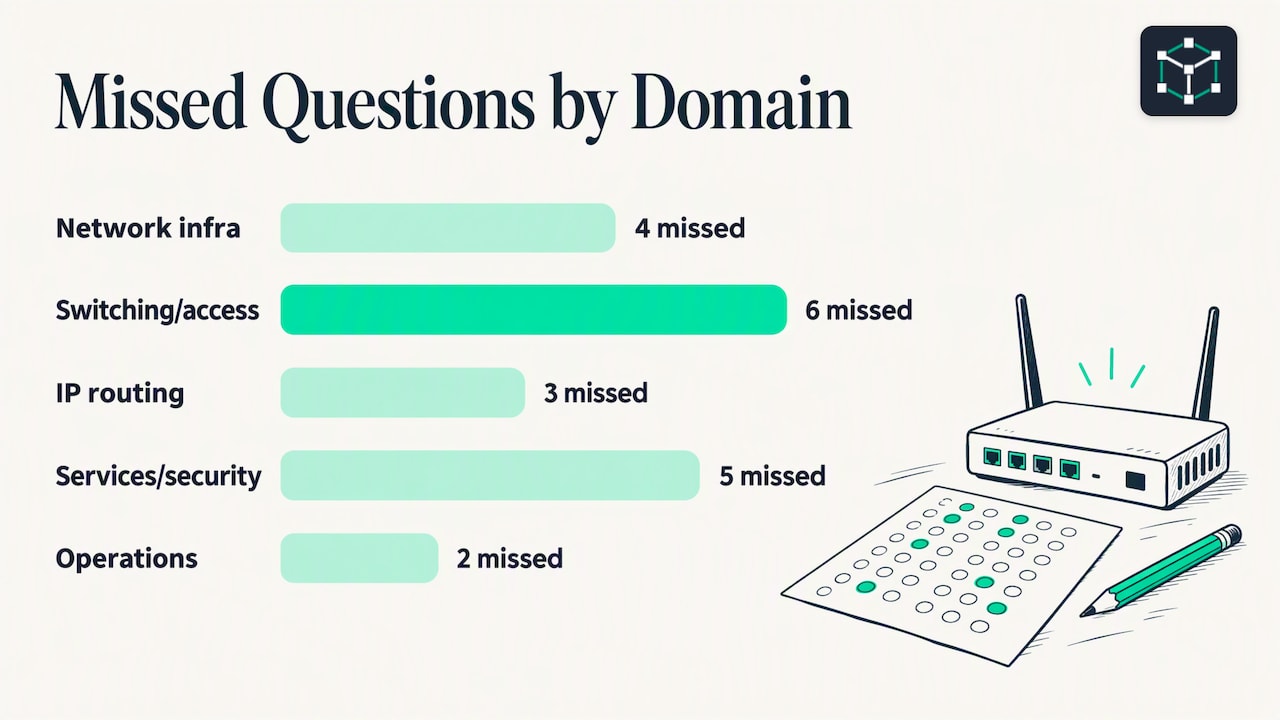
Suppose you take a 60-question diagnostic and score 58%. A raw percentage isn’t actionable, so break it down:
| Domain | Questions | Missed | Main cause |
|---|---|---|---|
| Network Infrastructure and Connectivity | 15 | 4 | Subnetting speed |
| Switching and Network Access | 15 | 6 | STP and EtherChannel concepts |
| IP Routing | 12 | 3 | OSPF neighbor states |
| Network Services and Security | 12 | 5 | ACL placement and NAT types |
| Operations (including AI) | 6 | 2 | Log severity levels |
The plan writes itself. Switching and Network Access gets the first block of study, with a lesson on STP followed by an EtherChannel lab. ACL and NAT come next, with a lab where you configure and verify both. Subnetting gets ten minutes of daily drills. Then you retest only those topics instead of retaking the whole exam.
This numeric example is illustrative, not a prediction about your results.
Lab-style questions: practice with a keyboard
Multiple-choice practice builds recognition. Networking jobs and lab-style exam items test production: can you configure a VLAN, verify a trunk or fix a broken static route?
Practice these in a virtual lab and follow a fixed habit:
- Read the task and sketch the topology.
- Configure one change at a time.
- Verify with
show ip interface brief,show vlan brief,show ip routeorshow running-config. - Break something on purpose and fix it using only
showandping.
The verification step is what separates passing from guessing. If you can predict what a show command will print before you press Enter, you understand the concept.
Is the CCNA hard, and what do scores tell you?
The CCNA is a broad associate-level exam. It spans switching, routing, wireless, security, services and now automation and AI-related operations topics, so the challenge is breadth plus hands-on accuracy rather than one hard concept. People who already work with networks find some domains easy and others new.
Practice tests help you judge readiness, within limits. Cisco does not publish a simple pass mark you can aim at, so no practice score guarantees a result. Use these signals instead:
- Your scores are consistent across several different question sets, not one lucky attempt.
- No single domain is far behind the others.
- You can explain why each wrong option is wrong.
- You finish timed attempts with minutes to spare.
- You can complete the core lab tasks from a blank configuration.
If you are consistently strong on those signals, book the exam. If one domain still lags, spend another week there rather than another full test.
Perspective: why we build practice around mistakes
We designed Subnetica around a simple observation: a practice test is only as useful as what happens after it.
Lessons on our platform are free, unlimited and bite-sized, so a missed question on OSPF or VLANs sends you to a short lesson on exactly that topic instead of a 40-page chapter. Labs are realistic and automatically graded, so you get feedback on the configuration you typed, not only on a multiple-choice letter.
Underneath, the learning path is data-driven. It learns from your mistakes, schedules spaced repetition reviews for the material you’re most likely to forget, and builds a study plan toward your goal. Our practice certification exams, available as a paid option with unlimited attempts, are meant for the final stretch, once the free lessons, quizzes and labs have closed your gaps.
Our view: treat every wrong answer as the most valuable data point you have.
Subnetica
Put the method to work
If you want a place to run this loop, start with the free lessons, quizzes and labs on Subnetica. Take a quiz on a topic, let the platform track your misses, and follow the review plan it builds. When you are ready for timed, exam-style attempts, the paid option gives you unlimited practice exams for CCNA or Network+.
Browse the interactive lessons, labs and practice exams and pick the domain where you scored lowest.
A four-week plan around practice tests
This outline assumes you have finished a first pass through the material. Adjust it to the time you have.
- Week 1: Diagnose. Take one mixed-domain test, log every miss, and rank domains by error count.
- Week 2: Repair the weakest two domains. Do a lesson, a lab and a short quiz for each weak topic. Drill subnetting daily.
- Week 3: Broaden. Take a second, different set of questions. Compare the domain breakdown with week 1 and confirm the gaps are shrinking.
- Week 4: Simulate. Take timed full-length exams, review every miss, and spend remaining days on the lowest topic only.
Don’t take the same test repeatedly until you know the answers. You start measuring recall of the question, not knowledge of the subject.
Common mistakes to avoid
- Memorizing answer letters. You need the reasoning, because the exam words things differently.
- Skipping subnetting practice. It feeds into routing, ACLs and addressing questions across domains.
- Ignoring the newer topics. Automation, wireless and operations topics are part of the blueprint, and the v2.0 update adds an AI-related component to the last domain.
- Studying only in test mode. Mix quizzes, reading, labs and spaced reviews.
- Treating one score as a verdict. Look at the trend over several attempts.
FAQ
Where can I get a free CCNA practice test?
Start with Cisco’s own Exam Review tool in the CCNA study materials plan, which includes nearly 300 questions and 15 lab exercises. You can also use the free, unlimited quizzes and labs on Subnetica to practice topic by topic. Both are good for diagnosis before you spend money on full-length exams.
How many practice tests should I take before the exam?
There is no official number. A sensible pattern is one baseline early, topic-level quizzes while you study, and two or three timed full-length exams at the end. What matters more is reviewing each miss and retesting the weak topic.
Are CCNA practice questions the same as the real exam questions?
No, and they shouldn’t be. Cisco maintains its exam through item writing, review and ongoing statistical monitoring, and legitimate practice material is written to match the topics, not copy the items. Choose questions that explain their answers and match the current blueprint.
What score on a practice test means I’m ready?
Cisco doesn’t publish a pass mark you can map onto practice scores, so use consistency instead. If you score well on several different question sets, no domain lags, and you can finish timed attempts with time to spare, you are likely ready to schedule.
Sources
- Cisco Learning Network: CCNA v2.0 Exam Topics
- Cisco Learning Network: CCNA Study Materials learning plan
- Cisco Learning Network: How Cisco Exams are Designed, Developed, and Maintained