A good online networking course teaches you how data moves between devices, then makes you prove it in hands-on labs. It should start from the basics (addressing, switching, routing) and let you set your own pace. It should also point at a goal, such as a CCNA or CompTIA Network+ exam. Judge any course on four things: coverage, lab quality, feedback on your mistakes, and whether the format fits your schedule. This guide shows you how to check each one.
TL;DR
- Look for a course that covers IP addressing, subnetting, switching, routing, network services and basic security, not just vocabulary.
- Hands-on labs matter more than video hours. Networking is a skill you build by configuring and troubleshooting.
- Self-paced study suits flexible schedules. Cohort study suits learners who want fixed deadlines and peers.
- If you are targeting CCNA or Network+, pick a course that maps to the exam topics and includes timed practice exams.
- You can start free: Subnetica offers unlimited bite-sized lessons, quizzes and labs at no cost.
Table of Contents
- What an online networking course should teach
- What you need before you start
- Why hands-on labs decide whether a course works
- Self-paced or instructor-led: choosing a format
- Preparing for CCNA or Network+ with an online course
- Free and paid online networking resources
- A checklist for evaluating any course
- Start learning networking with Subnetica
- How to keep going after the first month
- FAQ
- Sources
What an online networking course should teach
Networking is a layered subject. Each layer depends on the one below it, so a course that skips the foundations leaves gaps that show up later in routing and troubleshooting. Check that the syllabus builds in this order.
The fundamentals
The first block explains what a network is and how devices communicate. Expect these topics:
- The OSI and TCP/IP models, and what each layer is responsible for.
- Ethernet, MAC addresses, and how a switch builds its forwarding table.
- IPv4 and IPv6 addressing, including private ranges and address notation.
- Subnetting: splitting a network into smaller ones with a mask, and calculating network, broadcast and host ranges by hand.
- Core protocols such as ARP, ICMP, TCP and UDP.
Subnetting deserves special attention. It is the topic where most beginners stall, and it appears throughout every later topic. A course that treats it as one short video is a warning sign. Look for repeated practice problems with immediate answers.
Switching and routing
The second block moves from single links to whole networks:
- VLANs and trunks, which split one physical switch into several logical networks.
- Inter-VLAN routing, so separate segments can still talk to each other.
- Static routes, default routes, and how a router picks the most specific match in its routing table.
- Dynamic routing, usually starting with OSPF.
- Spanning Tree, which prevents loops in switched networks.
Network services and security
The third block covers what makes networks usable and safe:
- DHCP and DNS, the services that hand out addresses and resolve names.
- NAT, which lets private addresses reach the internet.
- Access control lists that permit or deny traffic.
- Wireless basics, device hardening, and common attack types.
- Monitoring, logging and the methodical troubleshooting that ties everything together.
Modern topics
Current certification syllabi also include network automation, programmability and cloud concepts. These are usually taught at the conceptual level for entry-level exams. You need to understand what an API or a configuration-management tool does before you use one at work.
What you need before you start
You do not need a degree or a job in IT to begin. Most beginner networking courses assume only three things:
- Basic computer literacy. You can install software, use a command line at a basic level, and find a device’s IP settings.
- Comfort with simple arithmetic. Subnetting uses binary numbers and powers of two. You learn these as you go, but patience with number practice helps.
- Willingness to type commands. Router and switch configuration happens in a text interface. You will repeat the same commands until they feel natural.
If your background is thin, pick a course with short lessons and instant quizzes. Small units make it easier to see what you did not understand before the gap grows. If you already work in help desk, systems or development, you can move faster through the basics and spend more time on routing and troubleshooting labs.
Why hands-on labs decide whether a course works
Reading about a routing table is not the same as fixing a broken one. Labs are where you connect concepts to behavior. When a ping fails, you have to work out whether the cause is an address, a mask, a gateway, a VLAN or an access list. That reasoning is what employers and exam questions both test.
A lab environment should let you do these things:
- Build or inspect a topology with several devices.
- Enter real configuration commands, not pick from a multiple-choice list.
- Break something, observe the symptom, and fix it.
- Receive automatic feedback so you know whether the result is correct.
Automatic grading is more important than it sounds. Without it, you can finish a lab, believe it worked, and carry a wrong habit forward for weeks. With it, each lab gives you a pass or a specific miss within seconds.
A simple lab routine
Use the same loop for every lab and you will learn faster:
- Read the objective and sketch the topology on paper.
- Write down the addressing plan before typing anything.
- Configure one device at a time and verify each step with a show command or a ping.
- When something fails, check from the bottom up: link, address, VLAN, route, then service.
- Redo the lab a few days later without looking at your notes.
Step five is the one people skip, and it is the one that moves a skill into long-term memory.
Self-paced or instructor-led: choosing a format
Online networking study comes in two main formats. In a self-paced course you watch lessons, take quizzes and finish assignments when you choose. In a cohort course, a group moves together through weekly assignments with a defined start and end. Wharton’s executive education team explains that self-paced study offers flexibility while cohort learning offers structure, peer interaction and accountability, and recommends weighing your goals, availability and learning style.
Apply that to networking:
| Factor | Self-paced | Cohort or instructor-led |
|---|---|---|
| Schedule | You decide when and how long | Fixed weekly commitments |
| Speed | Fast if you know the basics, slow if you need repetition | Set by the group |
| Accountability | Comes from you | Comes from deadlines and peers |
| Questions | Answered by built-in feedback, forums or hints | Answered by an instructor or classmates |
| Best for | Working adults, career changers, repeat learners | People who drift without deadlines |
Many learners combine both. They study on their own with a self-paced platform and add a study group or a mentor for accountability. If you choose self-paced, build your own structure: set a weekly goal, block fixed times on your calendar and track what you finish.
Preparing for CCNA or Network+ with an online course
Certifications give a course a finish line. The two most common entry points are Cisco’s CCNA and CompTIA’s Network+. Both cover core networking, but they lean differently:
- CCNA goes deeper on switching, routing and configuration of network devices, with a strong hands-on flavor.
- Network+ is vendor-neutral and broader, covering concepts, operations, security and troubleshooting across many kinds of equipment.
Check the current exam objectives on the certification body’s own site before you start, because both exams are revised periodically. Then compare each objective to the course syllabus. Every objective should appear somewhere in the lessons or labs.
A study plan that works for most people
- Set a target date that gives you enough weeks for steady, shorter sessions rather than rare marathons.
- Learn the topics in order, finishing quizzes at the end of each lesson.
- Do the labs for every topic before moving on.
- Review on a schedule. Spaced repetition brings back a topic just before you would forget it, which is far more efficient than rereading everything.
- Take practice exams under real conditions in the final weeks: timed, no notes, no pausing.
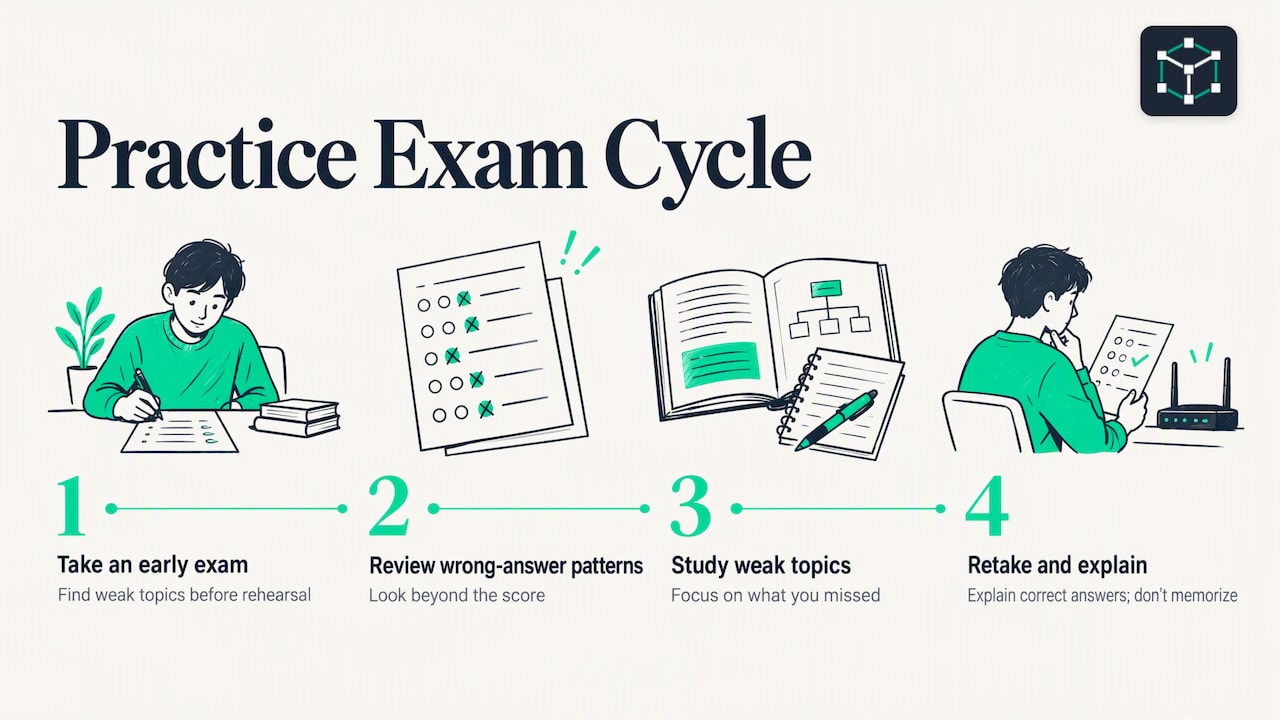
- Study your misses. Sort wrong answers by topic. If most come from subnetting or ACLs, spend your next sessions there.
Using practice exams well
A practice exam is a diagnostic tool before it is a rehearsal. Your score matters less than the pattern of wrong answers. Take one early to find weak topics, study those, and take another. Unlimited practice exams help here because each attempt gives you fresh material and a clearer view of your progress. Do not memorize answers: if you recognize a question but cannot explain why the correct option is correct, you have not learned it.
Free and paid online networking resources
You can learn a lot without spending money. The main types of resources are:
- Free interactive platforms with lessons, quizzes and labs.
- Free video series and documentation for explanations of specific topics.
- Network simulators you install on your own computer to build topologies.
- Paid video courses with a fixed curriculum, often with a completion certificate.
- Paid practice exams for certification preparation.
- Instructor-led bootcamps and cohort programs for a structured schedule with live help.
A sensible approach is to learn the material free, then pay only for what a free option does not give you, usually exam-style practice. Be careful with certificates of completion. They show you finished a course, but they are different from a vendor certification such as CCNA or Network+, which require passing the official exam.
A checklist for evaluating any course
Before you commit time to a course, run through these questions:
- Does the syllabus list specific topics, or just broad promises?
- Can you try lessons and labs before paying?
- Do labs let you type commands, and do they grade your result automatically?
- Does the course repeat topics over time, or teach them once and move on?
- Does it adapt to your weak areas?
- Are lessons short enough to fit a lunch break or a commute?
- Is the content current with the exam objectives you want?
- Is there a clear path from beginner topics to exam practice?
A course that answers yes to most of these is worth your time.
Our perspective on learning networking online
We built Subnetica around a simple belief: networking is learned by doing small things repeatedly, and getting told right away whether you did them correctly. That is why our lessons are bite-sized, free and unlimited. A ten-minute lesson followed by a quiz is easier to fit into a working week than a two-hour lecture, and it is easier to repeat.
Our labs are realistic and automatically graded. You configure the topology, and the platform checks the result, so you find out what worked and what did not without waiting for anyone. We think that kind of feedback is what turns reading into skill.
Our learning path is data-driven. It records which questions you miss, schedules spaced repetition reviews, and builds a study plan around your weak areas, so your time goes where it helps most. For learners aiming at CCNA or Network+, we offer unlimited practice certification exams as a paid option, so the final stretch of preparation is not limited by a small question bank.
We want a learner with no budget and a learner with an exam date to have the same quality of learning. The lessons, quizzes and labs stay free for both.
Subnetica
Start learning networking with Subnetica
If you want to try the approach described above, Subnetica’s free lessons, quizzes and labs are a direct way in. You can begin with the fundamentals, practice subnetting with immediate feedback, and move into labs that grade your configuration automatically. When you are ready for exam preparation, the platform offers unlimited practice exams for CCNA and Network+.
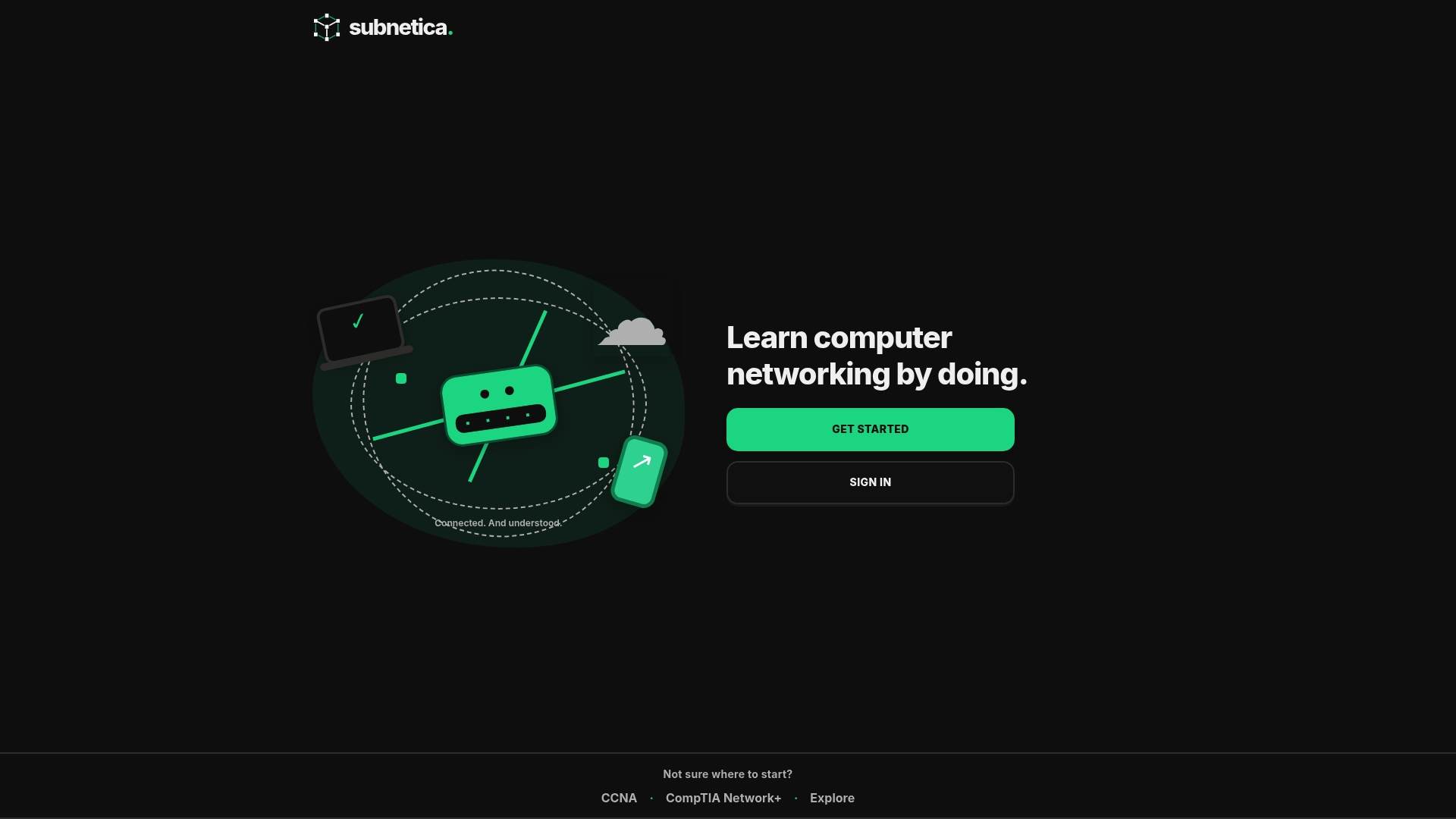
Start with one lesson today, then let the learning path suggest what to review next. You can find the full offering on the Subnetica home page.
How to keep going after the first month
Most people who quit a networking course do so in weeks three to six, when subnetting and routing overlap and progress feels slow. Plan for that dip.
- Keep sessions short and regular. Twenty-five focused minutes five days a week beats one long weekend session.
- Write your own summaries. Explain how a packet travels from one host to another in your own words, step by step.
- Draw topologies by hand. Label every interface with its address. It forces you to understand, not just recognize.
- Set up a small home lab. A simulator on your laptop lets you test ideas outside the course.
- Read real configurations. Once you recognize commands, they stop looking like noise.
- Track measurable goals. For example: subnet any /24 to /30 problem in under a minute, or complete three labs in a week.
If you are an instructor, short lessons, quizzes and graded labs can serve as supplemental work between class sessions. Students get immediate feedback without adding to your grading load.
FAQ
Can I learn computer networking online for free?
Yes. Free interactive lessons, quizzes and labs cover the core topics of switching, routing, addressing and services. On Subnetica, lessons, quizzes and labs are free and unlimited. You only need a paid option if you want unlimited practice certification exams.
How long does an online networking course take?
It depends on your starting point and weekly hours. Self-paced study lets you move faster through familiar topics and spend longer on difficult ones, so set a weekly time goal instead of a fixed finish date. Adjust the plan using your quiz and lab results.
Do I need experience in IT to start?
No. Basic computer skills and willingness to practice simple arithmetic and typed commands are enough for a beginner course. Short lessons with instant quizzes help you find gaps early.
Is an online course enough to prepare for CCNA or Network+?
A course that maps to the exam objectives, includes hands-on labs and offers timed practice exams can cover everything you need to study. Check the current objectives on the certification body’s site, and use practice exams to find weak topics before exam day.